
Wait, there’s a whole giant clam species hiding on our coral reefs?
A disclosure before we dive in. I'm one of the authors on the research paper this blog is about. So I’m breaking it down and sharing the science with you, without the jargon. Ok, maybe a little jargon. The full paper is published in the Coral Reefs journal and you can read it here.
This is exactly the kind of science rabbit hole I want to explore. That’s one of the things I love most about science and the ocean is that it never ceases to amaze me. And honestly, it’s a central part of Oceanelier too! The more you learn, the more you realise how much there is to learn.
Case in point: a species of giant clam that was hiding in plain sight.
You’ll love this.
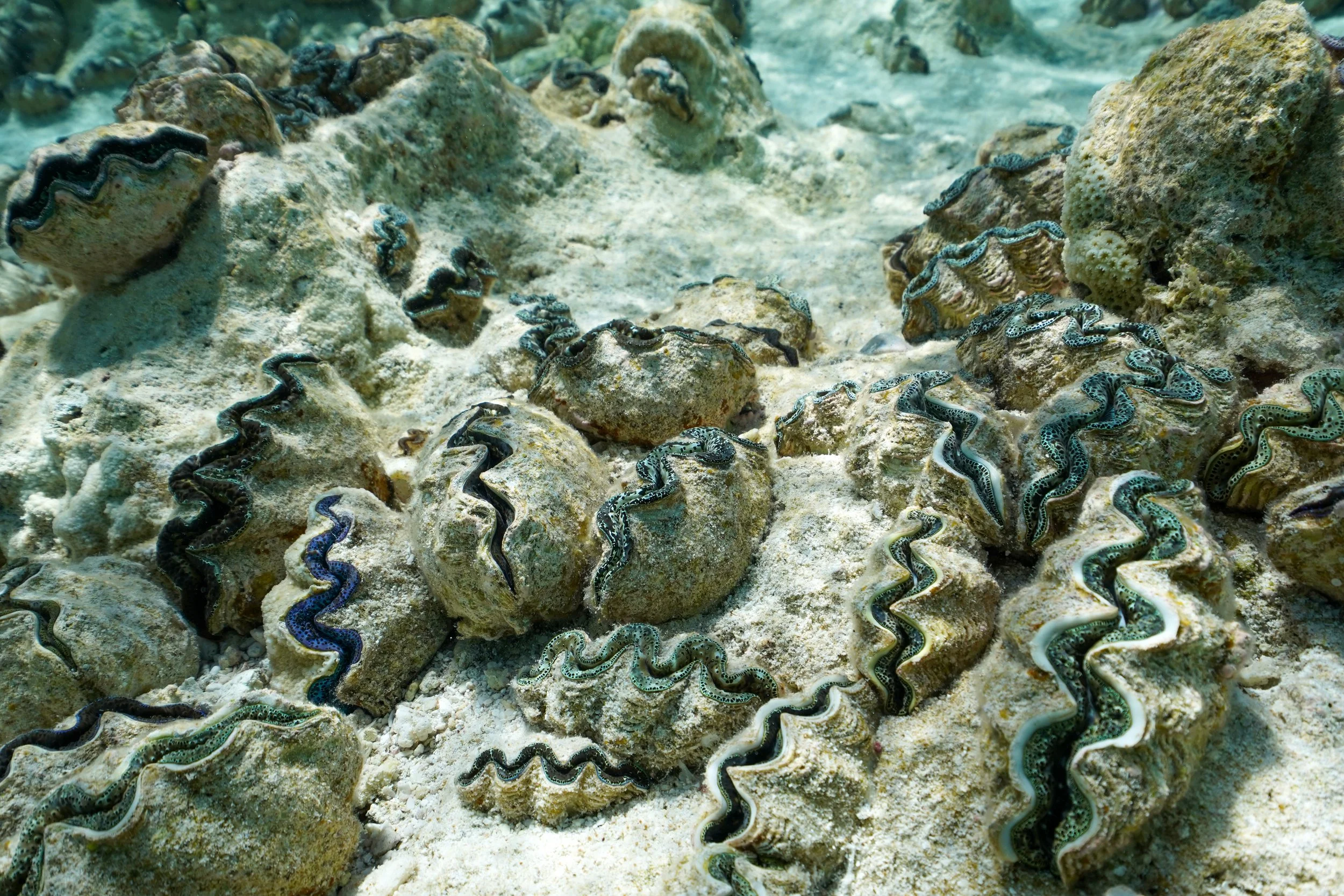
Tridacna maxima on a shallow coral reef in Aitutaki, Cook Islands. Photo by L. Ainley.
Fun fact: not all giant clams are the same
According to the IUCN Redlist, there are 12 known species of giant clams. I don’t know how many unknown or undiscovered species there are.
There's a giant clam called Tridacna noae, Noah’s Giant Clam (named after Noah’s Ark). For a long time, scientists weren't even sure it was its own species. It looked so similar to another giant clam, Tridacna maxima, the most common giant clam in the Indo Pacific, that the two kept getting confused and lumped together.
And that’s a bigger problem than it seems.
So what's the difference?
Both species are found in the Indo-Pacific, both hang out on coral reefs, and both have the kind of iridescent mantles that make you stop mid-dive and just stare. But T. noae was only formally recognised as its own valid species in 2014. That’s pretty recent in scientific terms. Before that, we didn’t know if it was just a variation of T. maxima.
The tricky bit is that you can't reliably tell them apart very well. The main visual clue is the mantle pattern where the T. noae tends to have lighter spots bound by white rings. And the ones we found in the Cook Islands all had a dark brown to near-black coloration (making those lighter spots harder to see). Beautiful, but cryptic.
So to be sure, we needed genetics.
What the marine science says
This research looked at the DNA (specifically, a mitochondrial gene called CO1, which works like a biological barcode for species identification) to confirm whether several specimens of clams that we found in the Cook Islands were genuinely T. noae.
The short answer: yes, they absolutely were. All six samples from Rarotonga came back as confirmed T. noae.
This is the first genetic confirmation of the species in the Cook Islands. That's meaningful.
And, because the Cook Islands is located more than 1,340 km south-east of American Samoa, which was the previous south-eastern limit of the confirmed T. noae range, finding them and genetically confirming their presence means extending the known range of its distribution. The study also found new haplotypes (haplotypes are combinations of genetic variants passed down from parent to offspring) that hadn’t been recorded before. This means that not only was the species confirmed to exist in the Cook Islands, they had also developed their own distinct genetic diversity too.
This is genuinely new information, new genetic diversity and important progress for marine science and ocean conservation in the Pacific.

Tridacna maxima on a shallow coral reef in the Cook Islands. Photo by L. Ainley.
Why ocean conservation depends on getting this right
Ok, this is the important bit.
Giant clams are iconic, but they aren't just beautiful marine animals. They are what marine scientists would call reef engineers. They contribute to coral reef structure, provide habitat for other species, help filter water, and are an important food source. They're also harvested for food and trade, which means their populations need careful, evidence-based management to avoid being wiped out.
And management works best when you know what you're managing.
If surveys have been counting T. noae as T. maxima, which is entirely possible, then the population numbers for T. maxima (and potentially other species) in the Cook Islands could be inflated. On the flip side, T. noae hadn’t previously been included in surveys before. So we don't know how abundant it is or what kind of harvest pressure it’s under.
So basically, we found a species that was hiding in plain sight, and now we need to figure out what that means for how we count and manage them.

Researching giant clams on the reef slope in Aitutaki, Cook Islands. Photo by L. Ainley.
What this means for the Pacific
Now that T. noae is confirmed in the Cook Islands, it can be more accurately identified, recorded, monitored and managed. Also, the genetic data from the study has been lodged in public databases so other researchers can use it and continue to grow our marine science knowledge.
There’s another, bigger picture message here too. There are probably many more places in the Pacific where this species hasn’t been officially confirmed yet. And, perhaps subject to the same misidentification issues. That’s a significant implication of Pacific-wide coral reef conservation and marine science. Another rabbit hole worth going down!
This is the kind of marine science that I find endlessly fascinating. My artwork through Oceanelier is not just ocean-inspired in an aesthetic way. It's inspired by species and research like this, inspired by lived experience and having known and seen these animals in the water.
The ocean is extraordinary. The more we understand it, the better we can look after it.
Giant clams have been living on these reefs for millions of years. The least we can do is learn to tell them apart.
Want to read the full paper? It's open access. No paywall, no fuss. Find it here.
Lara is the founder of Oceanelier, an ocean-inspired watercolour art studio based in Canberra, Australia. If you're an ocean lover, you're in the right place.
Shop prints at oceanelier.com.au or join the Ocean Lovers Club mailing list.


